
Diet Reference Archive: plate and portion tool
Harvard Healthy Eating Plate
A picture of a healthy meal from the Harvard T.H. Chan School of Public Health: half the plate vegetables and fruits, a quarter whole grains, a quarter healthy protein, with healthy oils, water, and a reminder to stay active. It is a teaching tool rather than a diet, and it is the client-facing picture this archive uses.
ON THIS PAGE
- In brief
- Overview
- In practice
- For the coach
- The evidence (opens on request)
- Mechanisms (opens on request)
- Risks, contraindications and myths (opens on request)
- Key terms
- Review questions
- References and Resources
- Evidence rating and review record
The summary and sections 1 to 3 are the short version and are open when the page loads. Sections 4 to 6 hold the research detail, the biology, and the cautions. Each of those opens when you select its heading, and you can read the page without opening them. Back to the Diet Reference Archive index.
In brief
What is it? A one-page picture of a healthy meal, published free by the Harvard T.H. Chan School of Public Health in 2011. Half the plate is vegetables and fruits, a quarter is whole grains, and a quarter is healthy protein, with a bottle of healthy oil, a glass of water, and a running figure beside it. The 4 food sections show proportions without fixed portions or calorie targets; separate drink advice limits dairy and juice. Clients may call it the Harvard plate.
Does it work? The searches for this page did not identify a controlled trial isolating the plate's effect. It appears as one part of larger programs, and sometimes as the standard advice a comparison group receives. One clinic study taught it to people with migraine without a comparison group, so it cannot show what the plate did. The school supports its plate with long-term studies of a related diet score, the Alternative Healthy Eating Index: people whose usual diets scored highest had lower rates of heart disease and death than people who scored lowest. Those studies show an association, not that handing someone the plate causes the benefit, and this page rates that association Low.
Is it safe? As general guidance for healthy adults, it carries no documented harm: none of the studies found for this page reported harms from it, though few looked for them. Because it does not set individualized amounts, it is not an individual meal plan. One study of the Spanish version found many single lunch plates built from it fell short of lunchtime targets for energy and several nutrients. Its limit on milk and dairy means calcium and vitamin D need another source for some people.
Who should not do it without talking to a doctor or dietitian first? People whose eating is part of a medical treatment plan, including kidney disease; people on insulin, a sulfonylurea or a meglitinide, or on warfarin, before a substantial change in what they eat; anyone pregnant or breastfeeding; children with a medical condition or a growth concern; and anyone with a history of disordered eating.
Related pages: Mediterranean Diet, Diabetes Plate Method, MyPlate, Whole Food Plant-Based Plate. Full list on the archive index.
1. Overview
What the plate shows
The Healthy Eating Plate is a drawing of a dinner plate divided into 4 colored sections, with 3 things beside it, offered as a guide to healthy, balanced meals "whether served at the table or packed in a lunch box" (Harvard T.H. Chan School of Public Health, n.d.-a). The printed plate carries short text beside each section:
- Vegetables, the larger share of the half. The more vegetables and the greater the variety, the better. Potatoes and French fries do not count.
- Fruits, the smaller share of the half. Plenty of fruits of all colors.
- Whole grains, a quarter. Whole wheat bread, whole grain pasta, brown rice and other whole grains, with refined grains such as white rice and white bread limited.
- Healthy protein, a quarter. Fish, poultry, beans and nuts, with red meat and cheese limited and bacon, cold cuts and other processed meats avoided.
- Healthy oils, in a bottle beside the plate. Olive, canola and other plant oils, with butter limited and trans fat avoided.
- Water, in a glass beside the plate. Water, tea or coffee with little or no sugar; milk and dairy limited to 1 to 2 servings a day and juice to 1 small glass; sugary drinks avoided.
- A running figure labeled "Stay active!"
The section sizes are proportions, not amounts: the school says they are not meant to prescribe calories or servings, because needs vary with age, sex, body size and activity (Harvard T.H. Chan School of Public Health, n.d.-a). Its summary message is about quality: the type of carbohydrate matters more than the amount, sugary drinks are best skipped, and healthy oils have no cap on the share of calories.
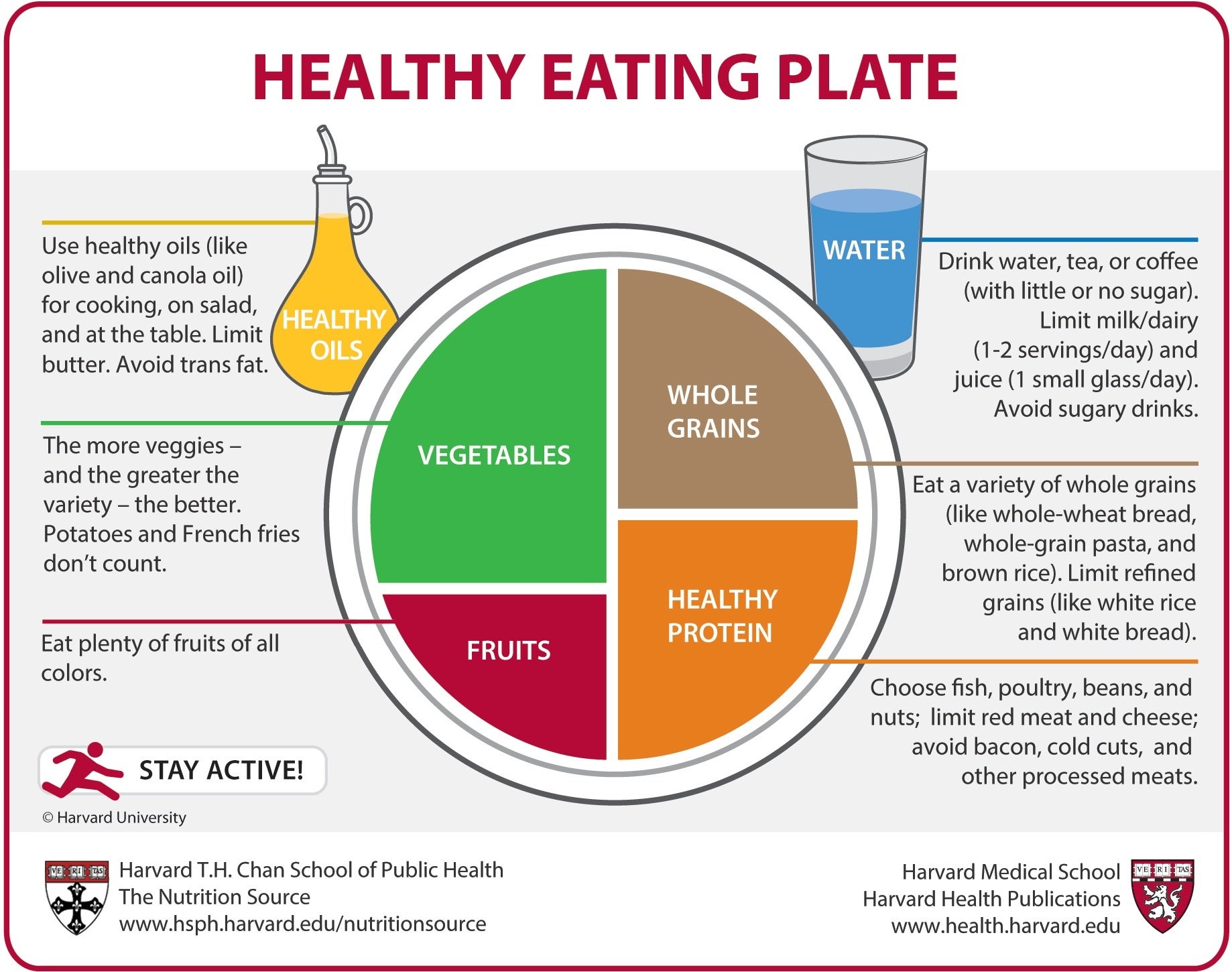
Copyright © 2011, Harvard University. For more information about The Healthy Eating Plate, please see The Nutrition Source, Department of Nutrition, Harvard T.H. Chan School of Public Health, www.thenutritionsource.org, and Harvard Health Publications, www.health.harvard.edu.
The image is the downloadable version the school offers for educational, non-commercial use with this credit line (Harvard T.H. Chan School of Public Health, n.d.-a). It is shown here unchanged.
What you avoid or limit
The plate has no list of banned foods and no rules about meal timing. It limits refined grains, red meat, cheese, butter, dairy beyond 1 to 2 servings a day and juice beyond a small glass, and says to avoid processed meats, trans fat and sugary drinks. Potatoes and French fries are not banned; they are left out of the vegetable count, and the 2011 announcement recommended limiting potatoes because their rapidly digested starch affects blood sugar like refined grains and sweets (Harvard School of Public Health, 2011). The plate does not mention sodium or ultraprocessed food.
Where it came from
Nutrition experts at the Harvard School of Public Health, with editors at Harvard Health Publications, released the plate on September 14, 2011, presenting it as a guide that "addresses important deficiencies" in the U.S. Department of Agriculture's MyPlate, introduced earlier that year (Jodkiewicz et al., 2025). The chair of the school's Department of Nutrition, Walter Willett, said MyPlate "mixes science with the influence of powerful agricultural interests" (Harvard School of Public Health, 2011).
The plate illustrates one way to build a meal within the school's Healthy Eating Pyramid, created in 2001 and updated in 2008 (Harvard School of Public Health, 2011), which the school still publishes as a companion grocery list (Harvard T.H. Chan School of Public Health, n.d.-d).
The plate has changed little since its launch. The 2011 announcement's protein advice named red and processed meats; the printed plate offered for download in 2026 also lists cheese among the foods to limit (Harvard School of Public Health, 2011; Harvard T.H. Chan School of Public Health, n.d.-a). The school later added a Kid's Healthy Eating Plate, copyrighted in 2015, and translations (Harvard T.H. Chan School of Public Health, n.d.-b, n.d.-e, 2016). The pages opened for this page give no dated list of changes; the plate's page says it was last reviewed in January 2023.
What it claims to do
The school says the plate is "based exclusively on the best available science" and was not shaped by food industry lobbyists, and that it gives "detailed guidance, in a simple format" (Harvard T.H. Chan School of Public Health, n.d.-a). Its health claim comes as an answer to whether following the plate and pyramid will make a person healthier: according to research at the school and elsewhere, following them "can lead to a lower risk of heart disease and premature death," citing studies of the Alternative Healthy Eating Index. The page also links the running figure to weight control. Section 4 sets the health claim against what those studies measured, and the review record says how this archive talks about weight.
What it gets right
The plate pictures several features that the American Heart Association's 2026 guidance names for a heart-healthy pattern: plenty of varied vegetables and fruits, mostly whole grains, healthy protein sources, unsaturated fats in place of saturated fats, and minimal added sugars (Lichtenstein et al., 2026). That statement, not the plate, is where this archive puts a nutrition claim, and it also names features the plate does not show, such as reducing sodium and choosing minimally processed foods.
For a client, it also needs no counting, names the healthier choice inside each food group, shows oils and a drink, is free to print, and leaves room for different food traditions.
How clients describe it, and what it gets confused with
Clients say "the Harvard plate," "half my plate vegetables," or "the plate with the oil and the water," often from a clinic handout, a school or a workplace poster.
It is most often confused with MyPlate, the U.S. Department of Agriculture's plate, described below. It is also confused with the Diabetes Plate Method from the American Diabetes Association, a tool for people with diabetes, and the Whole Food Plant-Based Plate from the American College of Lifestyle Medicine, which shows only plant foods. Other plates share the name: Poland's Healthy Eating Plate, introduced in 2020 from Polish guidance, differs from Harvard's on dairy (Malinowska et al., 2026; Jodkiewicz et al., 2025); a 2026 trial in women with endometriosis described its diet as a Healthy Eating Plate diet, and its methods show it used Poland's plate (Bogusz et al., 2026); and Spain's food safety and nutrition agency uses a plate it bases on Harvard's (Capitán-Gutiérrez et al., 2025). The first question about any study of "the Healthy Eating Plate" is which plate it used.
How it differs from MyPlate
The school publishes its own section-by-section comparison, a description by the plate's authors rather than an independent evaluation (Harvard T.H. Chan School of Public Health, n.d.-c). In its account, the Harvard plate asks for whole grains, while MyPlate, after a revision, suggests making at least half of grains whole; it names fish, poultry, beans and nuts and limits red and processed meat, while MyPlate's protein section "could be filled by a variety of sources, including a hamburger or hot dog"; it leaves potatoes out of the vegetable count; it shows healthy oil, while MyPlate "is silent on fat"; it limits dairy, while MyPlate shows dairy with every meal; and it includes physical activity.
2. In practice
A typical day of eating
This day is an illustration built from the plate's sections, not an individualized plan. The school's Plate and the Planet page offers a separate sample 7-day meal plan of about 2,500 calories for a plant-forward pattern (Harvard T.H. Chan School of Public Health, n.d.-f). Breakfast might be oatmeal with berries and walnuts, with coffee or tea; breakfast rarely fills every section. Lunch might be a salad of greens, tomatoes and cucumbers with olive oil, chickpeas, and whole grain bread, with water. Dinner might be baked salmon, brown rice, and roasted broccoli and carrots with an orange. Someone who cooks in one pot can use the same proportions when choosing what goes into the pot, which is the school's own suggestion for soups and mixed dishes (Harvard T.H. Chan School of Public Health, n.d.-a).
Cost, products, and who profits
The plate costs nothing to use. The school offers it as a free download for educational and other non-commercial use with its credit line; commercial reuse needs permission (Harvard T.H. Chan School of Public Health, n.d.-a). No product is attached to it. The Nutrition Source site, where the plate lives, asks readers for gifts.
No study found for this page measured whether eating by the Harvard plate costs more or less than a person's usual food. The closest evidence concerns the related diet score: among 78,191 women in the Nurses' Health Study, higher spending went with higher scores, but scores varied almost as widely within each spending group as across the whole sample, and spending on nuts, soy, beans and whole grains went with higher scores. The authors concluded that "large improvements in diet may be achieved without increased spending" (Bernstein et al., 2010). That study priced reported diets with national food-cost data, not what each woman paid, so it does not describe a family on a tight budget.
Access matters too: a modeling study using the Harvard plate as its reference diet estimated that in 2011 the world produced about 5 servings of fruits and vegetables per person per day against the 15 its reading of the plate called for (KC et al., 2018).
Environmental footprint
The school's Plate and the Planet page says animal-based foods, especially red meat and dairy, tend to have higher greenhouse gas emissions than plant foods; that is the school's claim (Harvard T.H. Chan School of Public Health, n.d.-f). The global modeling study above estimated that if everyone ate by its reading of the plate while keeping the current mix of animal and plant protein, farm-gate emissions would rise about 49 percent, because the protein quarter calls for more protein than the world produces; with red meat held to 2 servings a week the rise was much smaller, and with all protein from plants emissions fell about 37 percent. The authors say these results rest on how they translated a picture into servings (KC et al., 2018).
In the Nurses' Health Study II, diets in the top fifth of the related diet score had about 30 percent lower estimated greenhouse gas emissions than those in the bottom fifth, 2.6 against 3.7 kilograms of carbon dioxide equivalent a day, mostly from less red and processed meat (Musicus et al., 2022). Both studies are estimates, neither tested the plate, and the footprint of eating by the plate depends mostly on the protein quarter.
Cultural fit
Because the plate shows proportions rather than dishes, it can hold many food traditions. The school's translations page lists 34 versions, from Arabic and Chinese to Hausa, Haitian Creole, Spanish and Yoruba (Harvard T.H. Chan School of Public Health, n.d.-b), and the school encourages using the guide "in context of cultural and individual customs and preferences" (Harvard T.H. Chan School of Public Health, n.d.-a). The Kid's plate has been adapted for Spanish-speaking Latino families (Maafs-Rodríguez et al., 2022), and a pregnancy program in Mexico adapted the adult plate to traditional Mexican foods (Perichart-Perera et al., 2024).
Soups, stews and other dishes with liquid do not divide into sections; a Spanish study of the plate left them out for that reason (Capitán-Gutiérrez et al., 2025). The whole grain quarter asks the most of traditions built on white rice, white bread or refined-flour tortillas.
What makes people stop
Little research has asked why people stop using the plate. In an Italian headache clinic, about half of 97 adults taught the plate said they had followed it, and only 23 raised the authors' adherence score over 12 weeks; the authors suggested that preparing some meals, especially vegetables, may have been hard (Altamura et al., 2020). In a Spanish study, even trained nutrition students served very different amounts by the plate (Capitán-Gutiérrez et al., 2025), so a picture without amounts can be hard to apply consistently.
What happens when you stop
No study found for this page followed people after they stopped using the plate. The uncontrolled migraine study followed participants for 12 weeks after teaching (Altamura et al., 2020); the multicomponent programs that included the plate, such as a 1-year program for boys (Tosi et al., 2023), cannot establish the plate's long-term effect; and the long-term studies in section 4 measured usual diets, not use of the plate.
Common variations
- The Kid's Healthy Eating Plate, the school's version for children, with the same proportions, water as the drink of choice, and a message to trade "sit-time" for "fit-time"; it carries its own terms of use and credit line (Harvard T.H. Chan School of Public Health, n.d.-e).
- Translations of the adult plate in 34 versions (Harvard T.H. Chan School of Public Health, n.d.-b).
- The Healthy Eating Pyramid, the school's companion picture of the same advice as a grocery list (Harvard T.H. Chan School of Public Health, n.d.-d).
- National and program adaptations built on it, such as Spain's national plate (Capitán-Gutiérrez et al., 2025) and a Mexican pregnancy version (Perichart-Perera et al., 2024).
- Different plates that share or echo the name, such as Poland's Healthy Eating Plate (Malinowska et al., 2026). These are not versions of Harvard's plate.
- Other plates with different purposes: MyPlate, the Diabetes Plate Method and the Whole Food Plant-Based Plate.
3. For the coach
Who does what
- The physician or prescribing clinician
- Diagnoses and treats medical conditions, orders and reads labs, and adjusts any medicine affected by a change in eating, such as diabetes medicines or warfarin. Decides whether a client with kidney disease, diabetes or a pregnancy needs a plan other than general guidance.
- The registered dietitian
- Turns general guidance like the plate into an individual plan with amounts, fitted to a diagnosis, lab results, food traditions and budget, including calcium and vitamin D for someone who eats little dairy.
- The health and wellness coach
- With permission, shows the plate as a recognized authority's public picture of a healthy meal and asks what the client makes of it; helps the client explore their reasons, try the parts they choose, notice what makes it easier or harder, and plan next steps they own; and holds the referral line when medicine, a medical condition or eating distress comes up.
What a client bringing this tool needs
A client who brings the Harvard plate has usually seen it already. They may want to know whether it is "right," or how to make it work with shared meals, cafeteria lunches and a budget. The plate gives no amounts, which leaves the client to decide what goes on it and makes it no substitute for a dietitian when amounts matter medically. What the coaching conversation adds is clarity about the client's own reasons, a realistic look at which meals the picture fits, and a next step the client chooses.
What to ask
- "What did you notice when you first looked at this plate?"
- "When you picture a meal you eat most weeks, which parts already look like this, and which parts do not?"
- "If you wanted to try one part of it, which part feels most doable, and what would make it easier?"
- "Is there anyone on your health care team who should hear about the changes you are thinking of making?"
Referral red flags
Any of these means the client involves their physician, prescriber or dietitian rather than continuing with coaching alone.
- A client on insulin, a sulfonylurea or a meglitinide who plans a substantial change in how much carbohydrate they eat, or who reports feeling shaky, dizzy, confused or unusually irritable, which can be signs of low blood sugar (National Institute of Diabetes and Digestive and Kidney Diseases, n.d.); for an episode happening now, the client's own diabetes plan comes first, as section 6 explains.
- A client on warfarin who plans to eat much more leafy greens or plant oils (MedlinePlus, n.d.-a).
- A client with kidney disease, or who is pregnant, using the general plate in place of individual guidance.
- Weight lost without trying, which can signal a health problem and is a reason to see a clinician (MedlinePlus, n.d.-b).
- Eating that has become frightening, rigid or secret, or that is narrowing what the client eats, which goes through the coach’s own referral process, or to the client's clinician under an existing care plan for someone with a history of disordered eating.
Special populations
- Pregnancy and breastfeeding
- No study found for this page tested the Harvard plate on its own in pregnancy or while breastfeeding. A trial protocol from Mexico lists an adapted plate as one teaching theme inside intensive nutrition therapy for pregnant women with obesity, and describes a plan rather than results (Perichart-Perera et al., 2024). Nutrition in pregnancy is set by the prenatal care team.
- Children and adolescents
- The school's Kid's Healthy Eating Plate suggests asking a doctor about calcium and vitamin D for children who drink little or no milk (Harvard T.H. Chan School of Public Health, n.d.-e). No trial found for this page tested either plate on its own in children. It has been part of larger programs without comparison groups, such as an Italian primary school program that found no statistically significant improvement in body measures or diet adherence (Basilico, Conti, et al., 2025) and a program for boys with overweight or obesity built on the Mediterranean diet and the plate (Tosi et al., 2023). A child's plan for a medical or growth concern belongs with their pediatric care team.
- Older adults
- No study found for this page tested the plate on its own in older adults. In 2 Spanish trials it was part of what every participant or the comparison group received, so the trials did not test it (Murillo-Zaldívar et al., 2026; Galarregui et al., 2024). Older adults with poor appetite, chewing problems or unplanned weight loss need a clinician's or dietitian's attention.
- Athletes and people with high activity
- No study of the Harvard plate in athletes was found for this page. The plate sets no amounts, so it does not address the energy needs of heavy training, which a sports dietitian sets individually.
- People taking medication for diabetes, blood pressure, or blood thinning
- The plate does not interact with any medicine, but a substantial change in eating can, for example through less carbohydrate for someone on insulin or a sulfonylurea, or more leafy greens for someone on warfarin (section 6). The standing rule is that a client on these medicines, including blood pressure medicine, keeps the prescriber informed before a substantial change in eating, not after a problem appears.
- People with kidney disease
- The kidney care team sets each person's eating plan, depending on stage, lab results and dialysis. No study of the Harvard plate in kidney disease was found for this page. The plate's plant foods are not a hazard for everyone with kidney disease; the point is that the plan is individual.
- People with a history of disordered eating
- The plate has no counting, but it sorts foods into choose, limit and avoid, and any set of food rules can become rigid for some people. No study found for this page tested the plate in this group; in one Italian day hospital program for anorexia nervosa, a session on the Harvard plate was part of clinician-led treatment, which says nothing about the plate on its own (Meneguzzo et al., 2026). A coach who notices distress around eating uses their own referral process, or works within the client's existing care plan.
Client misconceptions
- "Harvard proved this plate prevents heart disease." The studies behind that claim followed people's usual diets and found that higher scores on a related diet score went with lower risk; no controlled trial isolating the plate's effect was identified in the searches for this page (section 4).
- "Potatoes are bad, and the plate bans them." The plate leaves potatoes out of its vegetable count because of their effect on blood sugar and recommends limiting them; it does not ban them (Harvard School of Public Health, 2011).
- "The plate means no dairy." It limits milk and dairy to 1 to 2 servings a day; it does not remove them (Harvard T.H. Chan School of Public Health, n.d.-a).
4. The evidence
(select the heading to open or close this section)
The research comes in 2 kinds that answer different questions. Studies that used the plate itself include one uncontrolled clinic study, an analysis of the meals a Spanish version produces, and trials in which the plate is one part of a larger package or the comparison group's advice; none isolates what the plate does for health. The evidence the school points to is different: long-term studies of a related diet score, the Alternative Healthy Eating Index, in which people whose usual diets scored highest had lower rates of chronic disease and death. Those studies describe an association; they did not test the plate.
Evidence from randomized controlled trials
A trial assigns people by chance to one approach or another, which is the strongest way to test whether the approach causes a result. The searches for this page found no randomized trial that assigned people to the Harvard plate on its own. They found the plate inside trials in 2 roles, and in both the comparison was about something else.
In some trials the plate is the comparison condition. In 127 adults aged 50 to 80 in Spain, the standard-recommendations group was advised to use the Harvard plate, and the trial tested a personalized strategy with a mobile app against that advice over 3 months (Galarregui et al., 2024). The abstract of a trial in 180 women undergoing in vitro fertilization names a Healthy Eating Plate comparator; the full Methods were unavailable to confirm the specific plate (Ghadimi Yari et al., 2026). These trials tested the addition, not the plate.
In a trial of 130 adults aged 60 and older in Spain, everyone attended an education session that covered the Harvard plate before randomization, so the later difference between groups is not about the plate (Murillo-Zaldívar et al., 2026).
Cardiometabolic outcomes
No randomized trial found for this page measured blood pressure, blood lipids, blood sugar, or heart attacks and strokes after teaching the plate on its own.
Cancer
No trial of the plate found for this page reported cancer outcomes. The cohort studies below report associations between the related diet score and cancer.
Body weight, as measured
No randomized trial found for this page compared body weight between people taught the plate and people who were not. In the uncontrolled migraine study below, median body mass index went from 23.21 to 23.14 over 12 weeks, and weight change was not found to be associated with the change in migraine days (Altamura et al., 2020). The archive reports weight as a measurement, never as a goal; the review record explains the rule.
Mortality
No trial of the plate found for this page reported deaths. The cohort studies below report associations between the related diet score and death.
Evidence from other study designs
Three kinds of study used the Harvard plate directly.
A clinic study of plate teaching. At a headache center in Rome, 204 adults with migraine enrolled and 97 completed an unblinded study registered as a trial (Altamura et al., 2020). People with a body mass index over 30 were excluded, and anyone whose preventive migraine medicine changed left the study. Each person was followed for 12 weeks before teaching as their own comparison. A nutritionist then explained the plate in an individual session of at least 15 minutes and gave a printed color copy with written guidance in Italian. Diet was measured by questionnaire and scored on a 10-point adherence score the authors built.
Across all 97, median monthly migraine days were 7 at teaching and 6 twelve weeks later, a change the study did not find statistically significant. Reported red and processed meat fell from 4 to 3 servings a week and water rose from 1 to 2 liters a day, but the median adherence score went from 4.67 to 4.33. The 23 people who raised their score had a larger fall in migraine days than the rest (p = 0.007), and no clear difference in disability scores was detected. That comparison is between people who changed their diet and people who did not, chosen after the fact, not between taught and untaught people. The authors name the lack of a control group as the main limitation and call for a randomized trial (Altamura et al., 2020).
A study of the meals a plate version produces. In Spain, 60 trained nutrition students were recruited to serve the 4 food sections of the national plate, which Spain's food safety and nutrition agency bases on Harvard's, onto plates of 6 sizes, and 46 of their records were valid for analysis; then 63 lunch plates were built from a university canteen's food, and 67,392 possible combinations were calculated (Capitán-Gutiérrez et al., 2025). The students served very different amounts of the same food, and more on larger plates. In more than half of the plates, energy, carbohydrate, fiber, calcium, magnesium, potassium, zinc, several B vitamins, and vitamins A and E fell short of lunchtime targets. The authors recommend caution in using the plate for teaching or clinical work until it is tested with real intake data.
The study judged single lunch plates, not whole days; it counted only the 4 food sections, not the separate oil bottle and drink shown beside the plate; and it used the Spanish version. It does show that a plate without amounts can produce widely varying meals, and it is the one published analysis found for this page that questions whether plate meals meet nutrient needs.
The plate as a yardstick. Researchers also use the plate to judge meals. An Italian university cafeteria study photographed 2,400 trays before and after nudges that included posters inspired by the Harvard plate, and more trays matched the plate afterward (Basilico, Zambon, et al., 2025); a Peruvian team built a 6-item healthy eating questionnaire on the plate (Javier-Aliaga et al., 2025). These studies treat the plate as a standard; they do not test whether following it improves health.
Evidence from long-term prospective cohort studies
A cohort study follows people who already eat a certain way; it can show that a way of eating goes with an outcome, not that it caused it. No cohort study found for this page measured use of the Harvard plate. The cohort evidence the school cites is about a diet score.
Researchers at the school created the Alternative Healthy Eating Index, which the school's page says was built to test the principles of its Healthy Eating Pyramid against the government's Healthy Eating Index (Harvard T.H. Chan School of Public Health, n.d.-a; McCullough et al., 2002). The 2010 version scores 11 foods and nutrients that predict chronic disease (Chiuve et al., 2012), rewarding vegetables, fruits, whole grains, nuts, legumes and healthy fats and penalizing sugary drinks, red and processed meat, trans fat and sodium (Musicus et al., 2022). It overlaps the plate closely but is calculated from what people report eating over months and includes items the plate does not show, such as sodium.
Cardiometabolic outcomes
In 38,615 men and 67,271 women followed for 8 to 12 years, those in the top fifth of the score had lower risk of major chronic disease than those in the bottom fifth (relative risk 0.80 in men, 0.89 in women), most strongly for cardiovascular disease (0.61 in men, 95 percent confidence interval 0.49 to 0.75; 0.72 in women, 0.60 to 0.86) (McCullough et al., 2002). Among 112,524 adults followed for 24 years in women and 22 years in men, the 2010 version's top fifth had a relative risk of 0.81 (0.77 to 0.85), most strongly for coronary heart disease and diabetes (Chiuve et al., 2012).
Other cohorts agree in direction: in the Women's Health Initiative Observational Study, which enrolled 93,676 women, an analysis of about 79,750 women free of cardiovascular disease at the start found a hazard ratio of 0.77 (0.70 to 0.84) for the top fifth (Belin et al., 2011), and in the Nurses' Health Study II a relative risk of 0.77 (0.66 to 0.89) (Musicus et al., 2022).
Cancer
The score was associated with cancer risk about as strongly as the government's index (Chiuve et al., 2012); it was not found to be associated with cancer death in the British Whitehall II study (Akbaraly et al., 2011) but was in the American cohorts followed for up to 36 years (Shan et al., 2023).
Body weight, as measured
The cohort studies reviewed here adjusted for body size or studied disease and death; none of them is evidence about the plate and body weight.
Mortality
In 75,230 women and 44,085 men followed for up to 36 years, the top fifth had a hazard ratio for death from any cause of 0.80 (0.77 to 0.82); 3 other healthy-eating scores gave 0.81 to 0.86 (Shan et al., 2023). Among 7,319 British civil servants followed for 18 years, the top third had a hazard ratio of 0.76 (0.61 to 0.95) (Akbaraly et al., 2011).
A 2020 meta-analysis of 113 cohort reports pooled the government's index, this score and the DASH score together and reported that the highest diet quality on any of them was associated with lower risk of death from any cause, cardiovascular disease, cancer, type 2 diabetes and neurodegenerative disease; the authors rated the credibility of these associations moderate with a tool called NutriGrade (Morze et al., 2020). This page read the full article; it does not report the pooled numbers because they combine 3 scores, and the rating covers the 3 scores together, not the plate. For this diet score alone, the review rated the cancer association low. The score was also associated with greater odds of reaching age 70 free of 11 major chronic diseases with intact thinking, physical function and mental health (odds ratio 1.86, 1.71 to 2.01) (Tessier et al., 2025).
Three cautions apply. People with higher scores also had higher socioeconomic status and more physical activity, and adjustment cannot remove every such difference (Tessier et al., 2025). Most participants were health professionals of European ancestry, though mortality findings held across the racial and ethnic groups studied (Shan et al., 2023). And the school's page is not always exact: it says a Women's Health Initiative analysis showed a pyramid-style diet "superior to following a low-fat diet," while that study compared 2 diet scores in an observational cohort (Belin et al., 2011), and its bracketed reference numbers do not all match its reference list.
Highlighted studies
These 4 studies carry the most weight for this page.
On a narrow screen, scroll the table sideways to see every column.
| Study | Design | Sample size | Duration | Finding | The limitation that matters |
|---|---|---|---|---|---|
| Altamura et al., 2020 (Italy) | Uncontrolled before-and-after study of one plate teaching session in a headache clinic | 204 adults with migraine enrolled, 97 completed | 12 weeks before and 12 weeks after teaching | No statistically significant change in migraine days across all 97; the 23 who raised their adherence score had a larger fall than the rest | No comparison group, and the "adherent" group was defined after the fact |
| Capitán-Gutiérrez et al., 2025 (Spain) | Laboratory and canteen analysis of meals built from Spain's plate, which is based on Harvard's | 60 trained students recruited, 46 valid records; 63 canteen plates; 67,392 calculated combinations | Single lunch meals | In more than half of plates, energy and several nutrients fell short of lunchtime targets; amounts varied widely | Judged one meal, not a day, and counted only the 4 food sections |
| Chiuve et al., 2012 (United States) | Prospective cohort study of the 2010 Alternative Healthy Eating Index | 71,495 women and 41,029 men | 24 years in women, 22 years in men | Top fifth against bottom fifth: relative risk 0.81 (0.77 to 0.85) for major chronic disease | Measures a diet score, not use of the plate; residual confounding possible |
| Shan et al., 2023 (United States) | Prospective cohort study of 4 healthy-eating scores | 75,230 women and 44,085 men | Up to 36 years | Top fifth against bottom fifth: hazard ratio 0.80 (0.77 to 0.82) for death from any cause | Same limits; mostly health professionals |
Head to head
The searches for this page found no study comparing the Harvard plate with another plate, such as MyPlate, the Diabetes Plate Method or the Whole Food Plant-Based Plate, on any health outcome. The comparisons that exist describe content: the school's own comparison with MyPlate (Harvard T.H. Chan School of Public Health, n.d.-c) and a 2025 review of 5 plate models (Jodkiewicz et al., 2025). In cohorts scored several ways, this diet score and other healthy-eating scores, including a Mediterranean score, went with similar reductions in risk of death (Shan et al., 2023); that compares scores, not plates. The Mediterranean Diet page describes that pattern's own trials.
Where the evidence is absent
- No randomized trial found for this page tested the Harvard plate on its own, as a handout or as teaching, against no plate or another plate.
- No study found for this page reported heart attacks, strokes, cancer or deaths among people taught or given the plate.
- No cohort study found for this page measured use of the plate itself; the long-term evidence concerns a diet score.
- No study found for this page tested the plate on its own in pregnancy, while breastfeeding, in children, in older adults, in athletes, in people with kidney disease, in people taking diabetes or blood-thinning medicines, or in people with a history of disordered eating; programs that included it did not isolate it.
- No study found for this page measured what eating by the plate costs, followed people after they stopped using it, or measured its footprint directly rather than by modeling.
- The one analysis of nutrient adequacy found for this page studied single lunch plates from a Spanish version, not whole days of eating.
5. Mechanisms
(optional reading; select the heading to open or close this section)
This section explains how the plate is thought to work. You can skip it. Nothing in the coaching sections depends on it.
Established mechanisms
This page found no study showing how the plate itself changes what people eat. Its effects, if any, would come through the food choices people make with it; the biology of those foods belongs to the evidence behind the American Heart Association's guidance (Lichtenstein et al., 2026) and the archive's pages on dietary patterns.
Proposed mechanisms
Authors studying Poland's plate propose that a plate format reduces mental effort by sorting a message into a few visual categories with short cues (Malinowska et al., 2026), and the migraine study's authors proposed effects through blood sugar that their study could not test (Altamura et al., 2020). The studies reviewed here did not test these proposed mechanisms for the Harvard plate itself. A proposed mechanism never supports a claim in section 4.
6. Risks, contraindications and myths
(select the heading to open or close this section)
None of the sources opened for this page carries a warning about the Harvard plate from a professional or regulatory body, so this section has no heading for one. Its cautions come from the one nutrient analysis found and from medication and care guidance cited below.
Nutrient gaps
The plate leaves out no food group, but it sets no amounts, so it does not guarantee that a person's needs are met. In the Spanish analysis, more than half of lunch plates fell short of lunchtime targets for energy, calcium and several other nutrients (Capitán-Gutiérrez et al., 2025), with the limits described in section 4. Calcium and vitamin D need attention for anyone who keeps dairy within the plate's limit or avoids it; the school's Kid's plate page says the right amount of dairy has yet to be determined and suggests asking a doctor about both for children who drink little or no milk (Harvard T.H. Chan School of Public Health, n.d.-e). Fitting these nutrients to a person is the dietitian's work.
Who should not follow it without medical supervision
The plate is general guidance for healthy adults. People whose eating is part of medical treatment should use it with their care team: people with kidney disease; people with diabetes on insulin, a sulfonylurea or a meglitinide; people taking warfarin; anyone pregnant or breastfeeding; children with a medical condition or growth concern; and anyone with a history of disordered eating.
Medication interactions
The plate does not interact with any medicine directly; what matters is that following it can change what a person eats. Insulin, sulfonylureas and meglitinides can cause blood sugar to fall too low when a person eats less carbohydrate than usual or skips meals (National Institute of Diabetes and Digestive and Kidney Diseases, n.d.). People taking warfarin are told to keep vitamin K-containing foods consistent from week to week, not to eat large amounts of leafy green vegetables or certain vegetable oils, and to talk with their doctor before changing their diet (MedlinePlus, n.d.-a); a client who plans to fill half the plate with greens is that case.
That is a reason to keep the prescriber informed before a substantial change, not a reason to avoid the plate, and a coach never comments on a dose. For a client who may be having a low blood sugar episode right then, the first step is the one in their own diabetes plan, with emergency help if the symptoms are severe or they cannot manage it; telling the prescriber is the separate step that follows (National Institute of Diabetes and Digestive and Kidney Diseases, n.d.).
Signs it is going wrong
Physical signs a coach or family member might notice are shakiness, dizziness, confusion or unusual irritability in someone on insulin, a sulfonylurea or a meglitinide, which can be signs of low blood sugar (National Institute of Diabetes and Digestive and Kidney Diseases, n.d.). For an episode that may be happening now, the first step is the one in the client's own diabetes plan, with emergency help for severe symptoms or an episode the person cannot manage, as described under medication interactions above; telling the prescriber is the separate step that follows. Working out the cause of a physical symptom is the clinician's job, not the coach's.
Eating behaviors are a separate matter and are read with care. Treating "limit" foods as forbidden, distress when a meal does not match the picture, skipping meals that cannot be made to fit, or pulling away from shared meals can each have ordinary explanations, such as a work schedule, the cost of food or what is available nearby, appetite, cultural practice, or household and personal preferences. The coach notices and asks what the behavior is for, whether it causes distress, whether it is narrowing what the person eats, and whether it gets in the way of daily life. A behavior on its own is not a diagnosis. Where the conversation raises a real concern, the coach follows their own referral process, or works within the client's existing care plan with their clinician.
Weight a client loses without meaning to is also a reason to involve their clinician, because it can signal a health problem; MedlinePlus describes unintentional weight loss as 10 pounds or 5 percent of normal weight over 6 to 12 months or less without a known reason (MedlinePlus, n.d.-b). It is never a goal or a sign the plate is working.
Myths and where they came from
- Myth: "Harvard proved this plate prevents heart disease."
- Where it came from: the school's page answers whether its guides will make a person healthier by citing studies of the Alternative Healthy Eating Index (Harvard T.H. Chan School of Public Health, n.d.-a), and a 2018 review for family physicians lists the plate among dietary patterns "supported by strong evidence" (Locke et al., 2018). What is true: those studies measured a diet score and found associations; no controlled trial isolating the plate's effect was identified in the searches for this page (section 4).
- Myth: "The plate bans potatoes."
- Where it came from: the line "Potatoes and French fries don't count." What is true: the plate leaves potatoes out of its vegetable count because of their effect on blood sugar and recommends limiting them, not avoiding them (Harvard School of Public Health, 2011). Other plates differ; the British Eatwell Guide lists potatoes among starchy foods (Jodkiewicz et al., 2025).
- Myth: "This is the government's plate."
- Where it came from: it looks like MyPlate, and some countries have built official plates on it. What is true: a school of public health created it as an alternative to MyPlate, not from guidelines formally endorsed by a scientific society or the U.S. government (Harvard School of Public Health, 2011; Capitán-Gutiérrez et al., 2025).
- Myth: "Every meal has to look exactly like the picture."
- Where it came from: the picture shows one plate. What is true: the school says the sections are approximate proportions and the guide works for soups, meals in courses and packed lunches, within cultural and individual customs (Harvard T.H. Chan School of Public Health, n.d.-a).
7. Key terms
- Healthy Eating Plate
- The Harvard T.H. Chan School of Public Health's 2011 picture of a healthy meal: half vegetables and fruits, a quarter whole grains, a quarter healthy protein, with healthy oils, water and physical activity beside it.
- MyPlate
- The U.S. Department of Agriculture's plate icon, introduced in 2011, which the Harvard plate was designed as an alternative to.
- Healthy Eating Pyramid
- The school's earlier picture of the same advice, created in 2001 and updated in 2008, which it now presents as a companion grocery list to the plate.
- Alternative Healthy Eating Index
- A diet score created by Harvard researchers that rates a person's usual diet on foods and nutrients linked to chronic disease; it measures diet quality, not use of the plate.
- Prospective cohort study
- A study that measures how people already eat and follows them forward to see who develops disease; it shows associations, not causes.
- Association
- A pattern in which 2 things tend to occur together, such as a higher diet score and lower risk of death, without showing that one causes the other.
- Uncontrolled before-and-after study
- A study that measures the same people before and after an intervention with no comparison group, so other causes of change cannot be ruled out.
- NutriGrade
- A tool for rating how credible the evidence from nutrition studies is, used by some reviews in place of GRADE.
8. Review questions
- Describe the Harvard Healthy Eating Plate: what fills each section, what sits beside the plate, and which foods it limits. Name 3 ways it differs from MyPlate, according to the school's own comparison.
- For readers who open section 4: the school says following its plate can lower the risk of heart disease and premature death. What did the studies it cites measure, in whom, and why does that evidence not show what handing a client the plate will do?
- For readers who open section 4: in the migraine study, who were the "adherents," how were they chosen, and why does the difference between them and everyone else not show that the plate reduced migraine?
- A client who takes warfarin says, "I saw the Harvard plate and I'm going to fill half of every plate with spinach and kale." What does the coach explore, and where is the referral line?
- For readers who open section 6: where does the idea that the plate bans potatoes come from, and what does the plate say?
9. References and Resources
Akbaraly, T. N., Ferrie, J. E., Berr, C., Brunner, E. J., Head, J., Marmot, M. G., Singh-Manoux, A., Ritchie, K., Shipley, M. J., & Kivimaki, M. (2011). Alternative Healthy Eating Index and mortality over 18 y of follow-up: Results from the Whitehall II cohort. American Journal of Clinical Nutrition, 94(1), 247-253. https://doi.org/10.3945/ajcn.111.013128
Altamura, C., Cecchi, G., Bravo, M., Brunelli, N., Laudisio, A., Di Caprio, P., Botti, G., Paolucci, M., Khazrai, Y. M., & Vernieri, F. (2020). The Healthy Eating Plate advice for migraine prevention: An interventional study. Nutrients, 12(6), Article 1579. https://doi.org/10.3390/nu12061579
Basilico, S., Conti, M. V., Ardoino, I., Breda, C., Loperfido, F., Orsini, F., Fernandez, M. L. O., Pierini, L., Bonizzoni, S. C., Modena, E., Villa, F., Cena, H., Baviera, M., & Franchi, C. (2025). Lights and shadows of a primary school-based nutrition education program in Italy: Insights from the LIVELY project. Nutrients, 17(17), Article 2778. https://doi.org/10.3390/nu17172778
Basilico, S., Zambon, I., De Giuseppe, R., Testa, L., Del Bo, A., Gamper, V., Moroni, V., Vanutelli, M. E., Tosun, H., Hpau Yam, H. L. M., Conti, M. V., & Cena, H. (2025). Nudging healthier and more sustainable eating habits in university cafeterias: The FOOD-HACK project. Nutrients, 17(22), Article 3562. https://doi.org/10.3390/nu17223562
Belin, R. J., Greenland, P., Allison, M., Martin, L., Shikany, J. M., Larson, J., Tinker, L., Howard, B. V., Lloyd-Jones, D., & Van Horn, L. (2011). Diet quality and the risk of cardiovascular disease: The Women's Health Initiative (WHI). American Journal of Clinical Nutrition, 94(1), 49-57. https://doi.org/10.3945/ajcn.110.011221
Bernstein, A. M., Bloom, D. E., Rosner, B. A., Franz, M., & Willett, W. C. (2010). Relation of food cost to healthfulness of diet among US women. American Journal of Clinical Nutrition, 92(5), 1197-1203. https://doi.org/10.3945/ajcn.2010.29854
Bogusz, A., Szewczyk, K., Włodarek, D., & Górnicka, M. (2026). Effect of fish-derived lipids on inflammation status and health-related quality of life in women with endometriosis. Nutrients, 18(13), Article 2184. https://doi.org/10.3390/nu18132184
Capitán-Gutiérrez, J. M., Moreno-Ortega, A., Valero, E., Urrialde, R., & Moreno-Rojas, R. (2025). Nutritional assessment of the Healthy Eating Plate as graphic tool from food dietary guidelines. Foods, 14(19), Article 3377. https://doi.org/10.3390/foods14193377
Chiuve, S. E., Fung, T. T., Rimm, E. B., Hu, F. B., McCullough, M. L., Wang, M., Stampfer, M. J., & Willett, W. C. (2012). Alternative dietary indices both strongly predict risk of chronic disease. Journal of Nutrition, 142(6), 1009-1018. https://doi.org/10.3945/jn.111.157222
Galarregui, C., Navas-Carretero, S., Zulet, M. A., González-Navarro, C. J., Martínez, J. A., de Cuevillas, B., Marcos-Pasero, H., Aguilar-Aguilar, E., Reglero, G., Ramirez de Molina, A., Chausa, P., Iniesta, J. M., Hernando, M. E., Gómez, E. J., Garcia-Rudolph, A., García-Molina, A., Loria-Kohen, V., & Abete, I. (2024). Precision nutrition impact on metabolic health and quality of life in aging population after a 3-month intervention: A randomized intervention. Journal of Nutrition, Health and Aging, 28(7), Article 100289. https://doi.org/10.1016/j.jnha.2024.100289
Ghadimi Yari, M., Ghasemi-Tehrani, H., Feizi, A., Ziaei, R., Derakhshan, M., & Rouhani, M. H. (2026). Effect of a pro-fertility diet combined with omega-3 supplementation on embryo quality in infertile women undergoing IVF: A randomized controlled trial. Reproductive BioMedicine Online, 53(3), Article 105661. https://doi.org/10.1016/j.rbmo.2026.105661
Harvard School of Public Health. (2011, September 14). Harvard researchers launch Healthy Eating Plate [Press release]. Archived copy, Internet Archive. web.archive.org/web/20141019072950/http://www.hsph.harvard.edu/news/press-releases/healthy-eating-plate
Harvard T.H. Chan School of Public Health. (n.d.-a). Healthy Eating Plate. The Nutrition Source. nutritionsource.hsph.harvard.edu/healthy-eating-plate
Harvard T.H. Chan School of Public Health. (n.d.-b). Healthy Eating Plate translations. The Nutrition Source. nutritionsource.hsph.harvard.edu/healthy-eating-plate/translations
Harvard T.H. Chan School of Public Health. (n.d.-c). Healthy Eating Plate vs. USDA's MyPlate. The Nutrition Source. nutritionsource.hsph.harvard.edu/healthy-eating-plate-vs-usda-myplate
Harvard T.H. Chan School of Public Health. (n.d.-d). Healthy Eating Pyramid. The Nutrition Source. nutritionsource.hsph.harvard.edu/healthy-eating-pyramid
Harvard T.H. Chan School of Public Health. (n.d.-e). Kid's Healthy Eating Plate. The Nutrition Source. nutritionsource.hsph.harvard.edu/kids-healthy-eating-plate
Harvard T.H. Chan School of Public Health. (n.d.-f). Plate and the planet. The Nutrition Source. nutritionsource.hsph.harvard.edu/sustainability/plate-and-planet
Harvard T.H. Chan School of Public Health. (2016, January 11). New! Kid's Healthy Eating Plate. The Nutrition Source. nutritionsource.hsph.harvard.edu/2016/01/11/new-kids-healthy-eating-plate
Javier-Aliaga, D., Quispe, G., Anicama, J., Mendigure Fernandez, J., Miranda-Limachi, K., Calizaya-Milla, Y. E., Gálvez-Díaz, N. D. C., Barreto-Espinoza, L. A., & Saintila, J. (2025). Creation and validation of the Brief Healthy Eating Habits Scale (BHEHS-6B, version 1.0), based on Harvard's Healthy Eating Plate, in a sample of young, middle-aged, and older Peruvian adults. Nutrients, 17(11), Article 1795. https://doi.org/10.3390/nu17111795
Jodkiewicz, M., Malinowska, J., & Marek-Woźny, K. (2025). A comparative analysis of graphic models for enhancing nutrition education. Nutrients, 17(12), Article 1947. https://doi.org/10.3390/nu17121947
KC, K. B., Dias, G. M., Veeramani, A., Swanton, C. J., Fraser, D., Steinke, D., Lee, E., Wittman, H., Farber, J. M., Dunfield, K., McCann, K., Anand, M., Campbell, M., Rooney, N., Raine, N. E., Acker, R. V., Hanner, R., Pascoal, S., Sharif, S., . . . Fraser, E. D. G. (2018). When too much isn't enough: Does current food production meet global nutritional needs? PLOS ONE, 13(10), Article e0205683. https://doi.org/10.1371/journal.pone.0205683
Lichtenstein, A. H., Khera, A., Anderson, C. A. M., Appel, L. J., DeSilva, D. M., Gardner, C., Hu, F. B., Jones, D. W., Petersen, K. S., & American Heart Association. (2026). 2026 dietary guidance to improve cardiovascular health: A scientific statement from the American Heart Association. Circulation, 153(18), e1285-e1295. https://doi.org/10.1161/CIR.0000000000001435
Locke, A., Schneiderhan, J., & Zick, S. M. (2018). Diets for health: Goals and guidelines. American Family Physician, 97(11), 721-728. aafp.org/pubs/afp/issues/2018/0601/p721.html
Maafs-Rodríguez, A., Otis, B., & Mattei, J. (2022). Cultural adaptation and social media promotion of healthy eating guides for Spanish speakers. Journal of Nutrition Education and Behavior, 54(9), 863-871. https://doi.org/10.1016/j.jneb.2022.03.008
Malinowska, J., Jodkiewicz, M., & Marek-Woźny, K. (2026). Immediate effects of brief exposure to the Healthy Eating Plate on adults' nutrition knowledge: A cross-sectional survey. Nutrients, 18(4), Article 697. https://doi.org/10.3390/nu18040697
McCullough, M. L., Feskanich, D., Stampfer, M. J., Giovannucci, E. L., Rimm, E. B., Hu, F. B., Spiegelman, D., Hunter, D. J., Colditz, G. A., & Willett, W. C. (2002). Diet quality and major chronic disease risk in men and women: Moving toward improved dietary guidance. American Journal of Clinical Nutrition, 76(6), 1261-1271. https://doi.org/10.1093/ajcn/76.6.1261
MedlinePlus. (n.d.-a). Warfarin. National Library of Medicine. medlineplus.gov/druginfo/meds/a682277.html
MedlinePlus. (n.d.-b). Weight loss - unintentional. National Library of Medicine. medlineplus.gov/ency/article/003107.htm
Meneguzzo, P., Zattarin, A., Carpin, A., Svaizer, A., Varotto, B., Salvador, Z., Marchetto, A., Veronese, A., & Favaro, A. (2026). Dietary fat and carbohydrate exposure during a group-based nutritional psychoeducational program in anorexia nervosa. Nutrients, 18(6), Article 902. https://doi.org/10.3390/nu18060902
Morze, J., Danielewicz, A., Hoffmann, G., & Schwingshackl, L. (2020). Diet quality as assessed by the Healthy Eating Index, Alternate Healthy Eating Index, Dietary Approaches to Stop Hypertension score, and health outcomes: A second update of a systematic review and meta-analysis of cohort studies. Journal of the Academy of Nutrition and Dietetics, 120(12), 1998-2031.e15. https://doi.org/10.1016/j.jand.2020.08.076
Murillo-Zaldívar, A. M., Alonso-Domínguez, R., González-Sánchez, J., Vicente-García, T., Recio-Rodríguez, J. I., Barbero-Iglesias, F. J., Sánchez-Tocino, M. L., García-Barrueco, L., García-Oterino, M., & González-Manzano, S. (2026). Effect of a multicomponent intervention on adherence to the Mediterranean diet in older adults: A randomized controlled trial. Frontiers in Nutrition, 13, Article 1918299. https://doi.org/10.3389/fnut.2026.1918299
Musicus, A. A., Wang, D. D., Janiszewski, M., Eshel, G., Blondin, S. A., Willett, W., & Stampfer, M. J. (2022). Health and environmental impacts of plant-rich dietary patterns: A US prospective cohort study. The Lancet Planetary Health, 6(11), e892-e900. https://doi.org/10.1016/S2542-5196(22)00243-1
National Institute of Diabetes and Digestive and Kidney Diseases. (n.d.). Low blood glucose (hypoglycemia). National Institutes of Health. niddk.nih.gov/health-information/diabetes/overview/preventing-problems/low-blood-glucose-hypoglycemia
Perichart-Perera, O., Reyes-Muñoz, E., Borboa-Olivares, H., Rodríguez-Cano, A. M., Solis Paredes, J. M., Hernández-Hernández, L., Rodríguez-Hernández, C., González-Ludlow, I., Suárez-Rico, B. V., Sánchez-Martínez, M., Torres-Herrera, U., Canul-Euan, A. A., Tolentino-Dolores, M., Espejel-Nuñez, A., & Estrada-Gutierrez, G. (2024). Optimizing perinatal wellbeing in pregnancy with obesity: A clinical trial with a multi-component nutrition intervention for prevention of gestational diabetes and infant growth and neurodevelopment impairment. Frontiers in Medicine, 11, Article 1339428. https://doi.org/10.3389/fmed.2024.1339428
Schünemann, H., Brożek, J., Guyatt, G., & Oxman, A. (Eds.). (2013). GRADE handbook: Handbook for grading the quality of evidence and the strength of recommendations using the GRADE approach (Updated October 2013). The GRADE Working Group. gdt.gradepro.org/app/handbook/handbook.html
Shan, Z., Wang, F., Li, Y., Baden, M. Y., Bhupathiraju, S. N., Wang, D. D., Sun, Q., Rexrode, K. M., Rimm, E. B., Qi, L., Tabung, F. K., Giovannucci, E. L., Willett, W. C., Manson, J. E., Qi, Q., & Hu, F. B. (2023). Healthy eating patterns and risk of total and cause-specific mortality. JAMA Internal Medicine, 183(2), 142-153. https://doi.org/10.1001/jamainternmed.2022.6117
Tessier, A.-J., Wang, F., Korat, A. A., Eliassen, A. H., Chavarro, J., Grodstein, F., Li, J., Liang, L., Willett, W. C., Sun, Q., Stampfer, M. J., Hu, F. B., & Guasch-Ferré, M. (2025). Optimal dietary patterns for healthy aging. Nature Medicine, 31(5), 1644-1652. https://doi.org/10.1038/s41591-025-03570-5
Tosi, M., Matelloni, I. A., Mancini, M., Andreassi, A., Scopari, A., Rossi, A., Verduci, E., Berra, C., Manfrini, R., Banderali, G., Pecori Giraldi, F., & Folli, F. (2023). Multiple beneficial effects of 1-year nutritional-behavioral intervention on anthropometric and metabolic parameters in overweight and obese boys. Journal of Endocrinological Investigation, 46(11), 2331-2342. https://doi.org/10.1007/s40618-023-02088-2
Evidence rating and review record
Each row identifies the method, source, outcome and comparison being rated. Ratings from different tools are not interchangeable. A rating may come from a named published review or from this page's own judgment. The Low labels in the banner rate the observed associations between Alternative Healthy Eating Index scores and disease or mortality; they do not rate the Harvard plate. A high rating means the research is solid; it does not mean a tool is right for everyone, and it does not mean a coach should recommend it.
Rows rated with GRADE use the same 4-level scale as the clinical guidelines you will meet in practice. High means further research is very unlikely to change the conclusion. Moderate means further research may change it. Low means further research is likely to change it. Very low means the conclusion is uncertain. GRADE rates each outcome separately, so the evidence for one outcome can be high and for another very low. A row marked Not rated is not a certainty level: it means there is no estimate of an effect to rate.
One row carries a published rating made with NutriGrade, a different tool used by some nutrition reviews. NutriGrade scores a body of evidence on 8 items (risk of bias, precision, heterogeneity, directness, publication bias, funding, effect size and dose-response) for a total of up to 10 points, and calls the credibility of the evidence high (8 to 10 points), moderate (6 to under 8), low (4 to under 6) or very low (under 4) (Morze et al., 2020). Its labels are not GRADE labels and are not converted to them.
On a narrow screen, scroll the table sideways to see every column.
| Outcome | Certainty | Who rated it, and for which comparison | Why it is rated this way |
|---|---|---|---|
| Any health outcome from being given or taught the Harvard plate on its own | Not rated | No controlled study isolating the plate was identified in the searches for this page. Comparison sought: people given or taught the plate against people given no plate or another tool, in any population, on any health outcome. | The searches for this page found the plate only as one part of larger programs or as the advice a comparison group received, so there is no estimate of the plate's own effect to rate. |
| Lower risk of cardiovascular disease and other major chronic disease with a higher Alternative Healthy Eating Index score (in the banner) | Low | This page's own judgment, with GRADE. Adults in 4 long-term prospective cohorts in the United States; top fifth of the diet score against bottom fifth; follow-up of 8 years to as long as 26 years. Studies: McCullough et al., 2002; Chiuve et al., 2012; Belin et al., 2011; Musicus et al., 2022. This rates the association of a diet score, not the effect of using the plate. | Prospective cohort studies start at Low under GRADE (Schünemann et al., 2013). Risk of bias: 3 of the cohorts repeatedly measured diet (McCullough et al., 2002; Chiuve et al., 2012; Musicus et al., 2022), but the Women's Health Initiative analysis used diet measured once, at the start (Belin et al., 2011). The studies adjusted for major measured confounders, but self-reported diet, measurement error and differences in socioeconomic circumstances and health habits leave residual confounding possible. For the association as framed, between a diet score and later disease, these limits are what place observational evidence at Low, and they are not judged an additional serious limitation, so the rating is not lowered further. This is not a causal effect of improving a score. Not lowered for inconsistency: all 4 cohorts found lower risk in the same direction. Not lowered for indirectness for the question as stated, the score and disease. Not lowered for imprecision: the confidence intervals are narrow. Publication bias could not be assessed with this set of studies. Not raised: the associations are moderate in size, relative risks of about 0.6 to 0.9. For the different question of what the plate does, this evidence would also be lowered for indirectness. |
| Lower risk of death from any cause with a higher Alternative Healthy Eating Index score (in the banner) | Low | This page's own judgment, with GRADE. Adults in 3 long-term prospective cohorts in the United States and Britain; top fifth against bottom fifth (Shan et al., 2023) and top third against bottom third (Akbaraly et al., 2011); follow-up of 18 to 36 years. Not a rating of the plate. | Starts at Low as above. Risk of bias: the Whitehall II analysis used diet measured once, at its baseline examination (Akbaraly et al., 2011), and both reports rest on self-reported diet; adjustment for measured confounders cannot rule out residual confounding by socioeconomic circumstances and health habits. For the association as framed, these limits are not judged an additional serious limitation beyond the observational starting point, so the rating is not lowered further; it is not a causal effect of improving a score. Not lowered for inconsistency: both reports found lower risk, hazard ratios 0.80 and 0.76. Direct for the score. Not lowered for imprecision: the larger study's interval is 0.77 to 0.82, although the British study's is wider, 0.61 to 0.95. Publication bias could not be assessed. Not raised: the association is moderate in size. |
| Lower risk of death, cardiovascular disease, cancer, type 2 diabetes and neurodegenerative disease with high diet quality on any of 3 scores | Moderate, rated with NutriGrade, not GRADE | Morze et al., 2020, the review's own rating with NutriGrade. Highest against lowest category of the Healthy Eating Index, the Alternative Healthy Eating Index or the DASH score, pooled together; 113 cohort reports. | The review authors' rating of the credibility of these associations, read from the full article's scoring table. The pooled scores earned full points for risk of bias, precision, heterogeneity, directness (except for neurodegenerative disease) and funding, part of the publication bias points for death and cardiovascular disease, and no points for effect size or dose-response, for totals of 6 to 7 out of 10. It covers 3 scores together and is not a rating of the Alternative Healthy Eating Index alone, for which the review rated the cancer association low, or of the plate. |
| Monthly migraine days after one plate teaching session | Very low | This page's own judgment. Adults with migraine at one Italian headache clinic, 97 who completed; the same people before and after one teaching session, and people who raised an adherence score against people who did not; 12 weeks. Study: Altamura et al., 2020. | An uncontrolled before-and-after study starts at Low. Lowered for very serious risk of bias: no comparison group, more than half of those enrolled did not complete, the adherent group was defined after the fact by a change in the authors' own score, and diet and migraine days were self-reported; the rating cannot fall below Very low. Inconsistency could not be judged with 1 study. Also serious indirectness, since the comparison is between people who changed their diet and people who did not, not between taught and untaught people, and serious imprecision, with 23 people in the adherent group. Publication bias could not be assessed. |
| Nutrient content of meals built from the plate | Not rated | One laboratory and canteen analysis of Spain's plate, which is based on Harvard's (Capitán-Gutiérrez et al., 2025). | The study estimates the nutrients in single lunch plates; it does not measure an effect of using the plate on people, so a GRADE certainty of effect does not apply. Section 4 reports its findings and limits. |
| Environmental footprint of eating by the plate | Not rated | Modeling studies of the plate and of the diet score (KC et al., 2018; Musicus et al., 2022). | Both estimate footprints from assumptions or food records rather than measuring an effect, and they depend on what fills the protein quarter; section 2 reports them as estimates. |
How this archive talks about weight. This page reports what studies measured, including body weight, and does not treat weight change as a goal or as a measure of a tool's success. Weight a person loses without meaning to can be a sign of a health problem, and where it is, the page names it as a reason to see a clinician. People are described the way the study described them.
Status: reviewed and approved by James Peth, MS, MPH, PhD, on October 6, 2026, after a combined final review and a limited recheck. Written October 2, 2026. The combined final review of the 3 plate pages was received on October 4, 2026, and its findings were repaired on October 4, 2026. All GRADE ratings on this page are its own, assigned from the evidence; the NutriGrade row is the published review's.
What changed: After the combined final review: a trial that used Poland's plate was moved out of the evidence on the Harvard plate and kept as an example of the name confusion; an in vitro fertilization trial is described as naming a Healthy Eating Plate whose identity could not be confirmed; one cohort's follow-up was corrected to 24 years in women and 22 years in men; the rating reasons now say which cohorts measured diet once; statements about what the searches did not find were narrowed; the summary now separates the food sections from the drink advice; the signs that something is going wrong now separate physical symptoms from eating behaviors; the explanation of rating methods, the table caption and the mentions of other archive pages were updated; and the meta-analysis rated with NutriGrade, 3 cohort studies, a cost study and a correction were read in full.
Updated October 21, 2026: The American Heart Association is now named as an author of its 2026 dietary guidance statement (Lichtenstein et al., 2026), as the publisher's citation credits it. No content changed.
Next scheduled review: Each year, because the school revises its plate pages and its terms of use. Pages built on annual guidance are rechecked each year.
Diet Reference Archive | One James
Prepared by James Peth, MS, MPH, PhD
© 2026–2027 One James. All rights reserved.
This page is for education and coaching practice. It is not medical or dietary advice.
